
If you’ve heard the term “CBCT” at a dental appointment, you might have wondered what it stands for and whether it’s really necessary. It sounds technical, but the concept is simple: it’s a special kind of 3D X-ray that gives your dentist a much clearer picture of what’s going on inside your mouth.
At Great Basin Dental in Reno, we use CBCT scan technology as part of our commitment to precise, comfortable care. Here’s what it is, how it works, and why it matters for your treatment.
What Does CBCT Stand For?
CBCT stands for Cone Beam Computed Tomography. That’s a mouthful, so most people just say “CBCT” or “cone beam scan.”
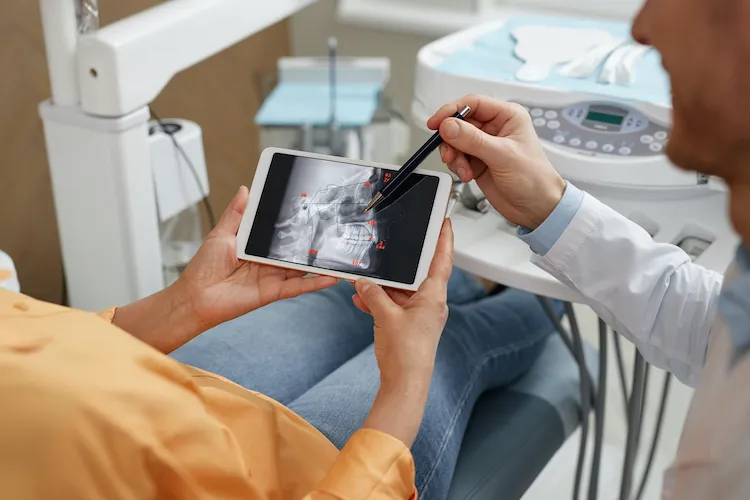
Think of it as a 3D map of your mouth. A traditional dental X-ray gives us a flat, two-dimensional image, like a photograph. A CBCT scan gives us a detailed, three-dimensional view of your teeth, jawbone, joints, and surrounding structures. We can rotate that image, view it from any angle, and see what a regular X-ray simply can’t show.
How Does It Work?
The process is quick and comfortable. You’ll sit or stand in a machine that looks a bit like a large, open ring. The scanner rotates around your head, capturing hundreds of images from different angles in seconds. A computer then combines those images into a detailed 3D model.
You don’t feel anything during the scan. There’s no poking or prodding, and you don’t have to bite down on anything. You just hold still for a moment, and it’s done.
Is It Safe?
Yes. CBCT scans use a low dose of radiation, significantly less than a traditional medical CT scan. The scan is fast, targeted, and done only when there’s a clear reason. We follow strict safety guidelines and only recommend imaging when it will genuinely help us plan or provide your care.
If you’re ever concerned, just ask. We’re happy to explain why we recommend a scan and what we’re looking for.
Why Does Your Reno, NV, Dentist Use CBCT?
This is where it gets interesting. A CBCT scan isn’t routine for every patient; we use it when we need a deeper look. Here are some of the most common reasons:
- Planning dental implants: This is one of the biggest uses. Before placing or restoring an implant, we need to know exactly how much bone is available, where nerves and blood vessels run, and how to position the implant. A CBCT scan gives us that information with incredible precision.
- Planning dentures: For patients getting custom dentures, a CBCT scan helps us understand the shape of the jawbone and soft tissues so the dentures fit comfortably and function well.
- Evaluating the jaw joints: If you have TMJ symptoms, a CBCT scan can show us the condition of the joint itself, something a regular X-ray can’t do.
- Finding hidden problems: Sometimes infections, chips, or impacted teeth don’t show up clearly on standard X-rays. A 3D scan can reveal issues that might otherwise go unnoticed.
- Planning root canals and other procedures: For complex cases, the detailed anatomy helps us work more accurately and safely.
What This Means for You
Better information leads to better care. When we can see your anatomy in three dimensions, we can plan treatments with more confidence, avoid surprises, and reduce the risk of complications. That means fewer adjustments, more predictable results, and a smoother experience overall.
At Great Basin Dental, Dr. Sievert and Dr. Guillen use CBCT scanning because it helps them provide the kind of precise, personalized care every patient deserves. It’s not about fancy technology for its own sake; it’s about using the right tools to get the best outcomes.
Questions? Just Ask
If you’re curious about CBCT scanning or want to know whether it might be part of your treatment plan, we’d love to talk with you. Our team is always happy to explain what we’re doing and why, because when you understand your care, you feel more confident.
Call our Reno office at 775-363-9644 or request an appointment online. We’re here to help you see the big picture.